
In accordance with its mission statement, SRC strives to conduct research of benefit to the community, in partnership with the community.

Community Engagement (CE) Processes and Activities.
Community Engagement is an integral part of our research process and has been in place since inception of the organisation. The community engagement team has managed to establish a strong foothold in the community over the years, which has contributed greatly towards the success of clinical trials conducted at SRC. CE includes partnering and networking with different stakeholders within the community and surrounding areas as well as providing community education, conducting social outreach programmes, workshops and other interventions.
Community engagement is not a stand-alone process, which can be conducted by us alone, but rather it is reliant on partnering with various other stakeholders, organisations and individuals who also have an interest in the community. We have an established database of various organisations and other stakeholders which includes local Non-Government Organisations (NGO’s), activist groups and other individuals or organisations. These all form a key component in our community engagement process and we often partner with these organisations in the conducting of our community engagement activities.
Setshaba has formed strong community relations over the years through carefully negotiated community engagement (CE) and education processes and has gained the trust of the community.
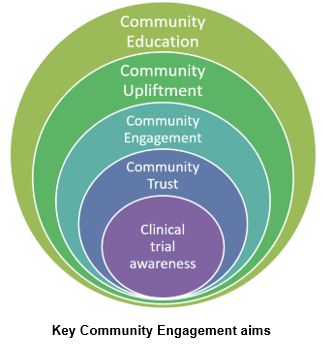

Community Education.
Community education is a fundamental pillar of a successful clinical research centre, acting as the critical link between scientific innovation and public health improvement. It involves proactive, bidirectional communication to raise awareness, build trust, and ensure that research is relevant, ethical, and accessible to the community it serves.
We believe that Community Education and Engagement is an ethical imperative that embeds us a trusted community partner, leading to better science and improved health outcomes.
CAB members are volunteers who serve in an advisory capacity to the SRC and provide input on important aspects of the trials conducted. CAB also serves to educate the community on research and the SRC’s position within the area.CAB members are trained in research literacy, ethics in research, basic aspects of HIV transmission, prevention, treatment and management and on specific protocols.
“Ubuntu is not just a concept we love, its a concept we LIVE.”
Social Responsibility.
SRC is a community based centre, that aims to work in partnership with the community, for the benefit of the community. We recognise our responsibility to the community and therefore in addition to research activities, SRC has conducted many social outreach programs including Health Expo’s, winter warmth programs, soup kitchens and other similar events. SRC has a standing relationship with the surrounding Orphanages whereby SRC continues to extend its support.
SRC has also provided support to local clinics in Soshanguve during April and May 2020, in response to the COVID-19 pandemic. Equipment such as gazebos, chairs and personal protective equipment (PPE) were donated to local clinics, to assist them in combating COVID-19.
Call Our Experts